


The adoption of Artificial Intelligence (AI) continues to grow in today's world, and among the numerous concerns being raised, environmental impacts have received the greatest emphasis. While there has been considerable public debate surrounding the energy consumption of AI data centres, their water consumption has received almost no attention – until now (Updated April 2025).
What are AI data centres?

Artificial Intelligence (AI) data centres are physical facilities housing the massive computing power and storage capacity that allow chatbots like ChatGPT to learn and retain information. Across the globe, these centres occupy vast warehouse spaces and require continuous electricity supply around the clock, with precisely controlled internal environments to ensure optimal technological performance.
Consequently, data centres have drawn negative media scrutiny for their substantial energy consumption. Research from the University of California Riverside and University of Texas Arlington, titled 'Making AI Less "Thirsty": Uncovering and Addressing the Secret Water Footprint of AI Models', estimates that AI data centres collectively consume 2% of all electricity generated worldwide¹.
However, the water consumption of these facilities remains far less publicised. Regarding the UK Government's ambitions to establish the country as a global AI leader, BBC News recently cited Dr Venkatesh Uddameri, a water resources management expert, who noted that a typical data centre can consume between 11 million and 19 million litres of water daily – equivalent to the usage of a town with 30,000 to 50,000 residents².
In regions hosting multiple data centres, this creates substantial pressure on local water supplies. Virginia, for instance, which hosts the world's highest concentration of data centres, experienced a two-thirds increase in water usage between 2019 and 2023, rising from 1.13 billion gallons to 1.85 billion gallons³.
Why do AI data centres use so much water?
AI data centres consume water in two ways – directly and indirectly – and consume the most during the ‘training’ phase: the period in which AI is fed data and programmed how to respond.
Indirect consumption is the water that is used off-site in the generation of power. An example of this could be the water used in the cooling towers of coal-fired power stations. Although AI data centres do not directly consume this water, their enormous demand for power means that to keep the centres running all day, more water is used in comparison with other types of facilities.
Direct water consumption is the water that is used on-site by the data centre for its own cooling purposes. Almost all of the power put into data centre servers is converted into heat, and the sheer size of the units only exacerbates this, so in order to maintain stable functional temperatures, water is passed through a heat exchange system to cool the equipment and stop it from overheating.
Water for cooling purposes is also needed to respond to changes in external temperature caused by seasonal weather patterns. This is of particular concern considering the increasing frequency of hotter summers and the resulting water scarcity that is experienced across the globe. As a result, there is the potential implication that data centres are consuming water that should be reserved for at-risk communities.
The water consumption for US-based facilities may be striking, but the research in ‘Making AI Less “Thirsty”’ also suggests that data centres in Asia could use as much as three times the amount of water as their western equivalents. This is worrying considering that by 2030 it is predicted that half of the world’s population will face severe water stress.
Two important caveats
Whilst this new research paper is compelling, it is important to remember that data on this subject is scarce; partly because little research has been undertaken to discover the water usage of data centres, and partly because – as the paper suggests – tech companies are keen to hide the true cost of AI technology. It is also important to consider that, whilst this report has had wide coverage in the press, this research and its methodology has – at time of writing in May 2023 (updated in April 2025) – not been peer reviewed. Whilst this does not undermine the potential importance of the research it does mean that further investigation will be needed before we can conclusively conclude AI data centres.
What can be done about it?
In the meantime, the researchers behind ‘Making AI Less “Thirsty”’ suggest that when and where AI chatbots are trained has a massive impact on the amount of water they use. The importance of geographic location in determining the sites for data centres should therefore be a top priority for tech companies, as should the timing of the training process in the calendar year.
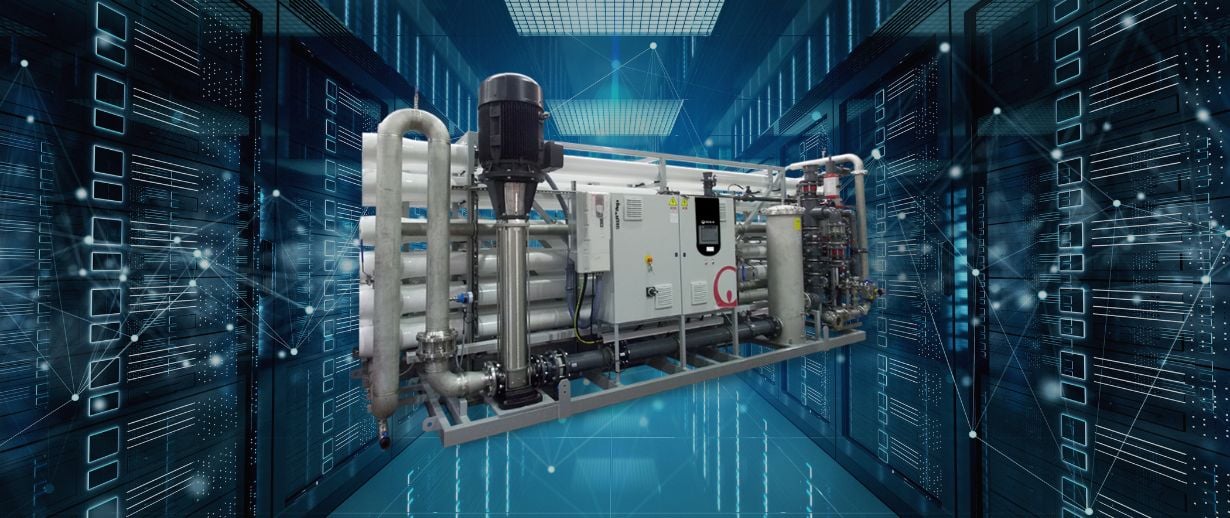
However, measures can also be implemented to reduce a data centre’s cooling water usage regardless of location. For example, our SIRION™ Mega SF and TF models offer high flux, low energy reverse osmosis (RO) with minimal requirement for additional civil engineering. As a result, 98% of dissolved organics can be removed from a centre’s wastewater, allowing it to be recycled for use in a cooling tower and cut water consumption – all whilst saving up to 50% on electrical power versus a conventional unit. When combined with our Ionsoft™ systems, RO units can further reduce the amount of water put to drain – enabling data centres to operate more sustainably and helping to reduce operating costs.
In February this year, a report by the National Engineering Policy Centre (NEPC) called for the UK government to make tech companies submit mandatory reports on their water consumption, withdrawal and water sources4. As such, it may soon become necessary for data centre facilities to implement more efficient solutions. Our water treatment experts can visit facilities to help improve the efficiency of an existing system or help clients design a new one. Their expertise can ensure that systems run optimally with minimal waste and the reduced likelihood of outages.
1 Making AI Less “Thirsty”: Uncovering and Addressing the Secret Water Footprint of AI Models - https://arxiv.org/abs/2304.03271
2 BBC News: Concern UK’s AI ambitions could lead to water shortages - https://www.bbc.co.uk/news/articles/ce85wx9jjndo
3 Demand for AI is driving data center water consumption sky high - https://techcrunch.com/2024/08/19/demand-for-ai-is-driving-data-center-water-consumption-sky-high/.
4 Engineering Responsible AI: foundations for environmentally sustainable AI - https://raeng.org.uk/media/2aggau2j/foundations-for-environmentally-sustainable-ai-nepc-report.pdf