.png)


Why ion exchange-reliant industries require a water treatment contingency plan and how mobile reverse osmosis (RO) and electrodeionization (EDI) technology can decrease caustic usage and maintain plant operations
What is the issue with caustic soda?
Caustic soda prices are rising again across Europe, and, if you oversee water treatment operations in a heavy process industry, you've probably felt it already. Energy market pressures, tightening chemical feedstock availability, and ongoing global supply chain disruption are once again driving sodium hydroxide (NaOH) prices sharply upward.
For many plant managers and operations directors, this situation will feel uncomfortably familiar. Once again, European industrial facilities are at risk of facing unplanned downtime or alterations to production schedules and operations - not because of process failures, but because they cannot source the chemicals needed to keep their water treatment systems running
The question is not whether prices will continue to be volatile, but what is your plan to reduce the impact?
Why heavy process industries are particularly vulnerable
To understand the risk, it helps to understand the dependency. The majority of heavy process industries, such as power generation, pharmaceuticals, chemical manufacturing, food and beverage, pulp and paper, rely on ion exchange (IX) systems to produce the high-purity or demineralised water their processes demand. Caustic soda, or rather, sodium hydroxide (NaOH), is the chemical used to regenerate the anion resin beds within these systems, restoring their capacity to remove dissolved ions from water. Ion exchange resin beds work by capturing dissolved ions from the feedwater, but they have a finite capacity. Once exhausted, they must be chemically regenerated and that regeneration requires caustic soda for anion resin regeneration, alongside acid for the cation resin.
The harder the feedwater and the higher the water demand, the more frequently those regeneration cycles occur. For a large industrial site, caustic consumption can run to several tonnes per month.
When caustic prices double or triple, as they have done in previous periods of supply stress, the operational cost of IX-based water treatment escalates rapidly. But cost is only part of the problem. Price spikes are frequently accompanied by availability constraints. There may come a point where you cannot source what you need at any price, regardless of budget.
A single day of unplanned shutdown in a heavy process facility can cost tens of thousands to millions of euros in lost production, contractual penalties and recovery costs. For industries with regulatory obligations around water quality, such as pharmaceutical manufacturing or power generation, the stakes are even higher.
What should industrial plants do when caustic soda prices increase?
The good news is that proven, rapidly deployable technology exists to reduce your sodium hydroxide dependency. Mobile water treatment solutions provide two key benefits:
- Reduce how much caustic your existing IX plant consumes.
- Replace chemical regeneration almost entirely.
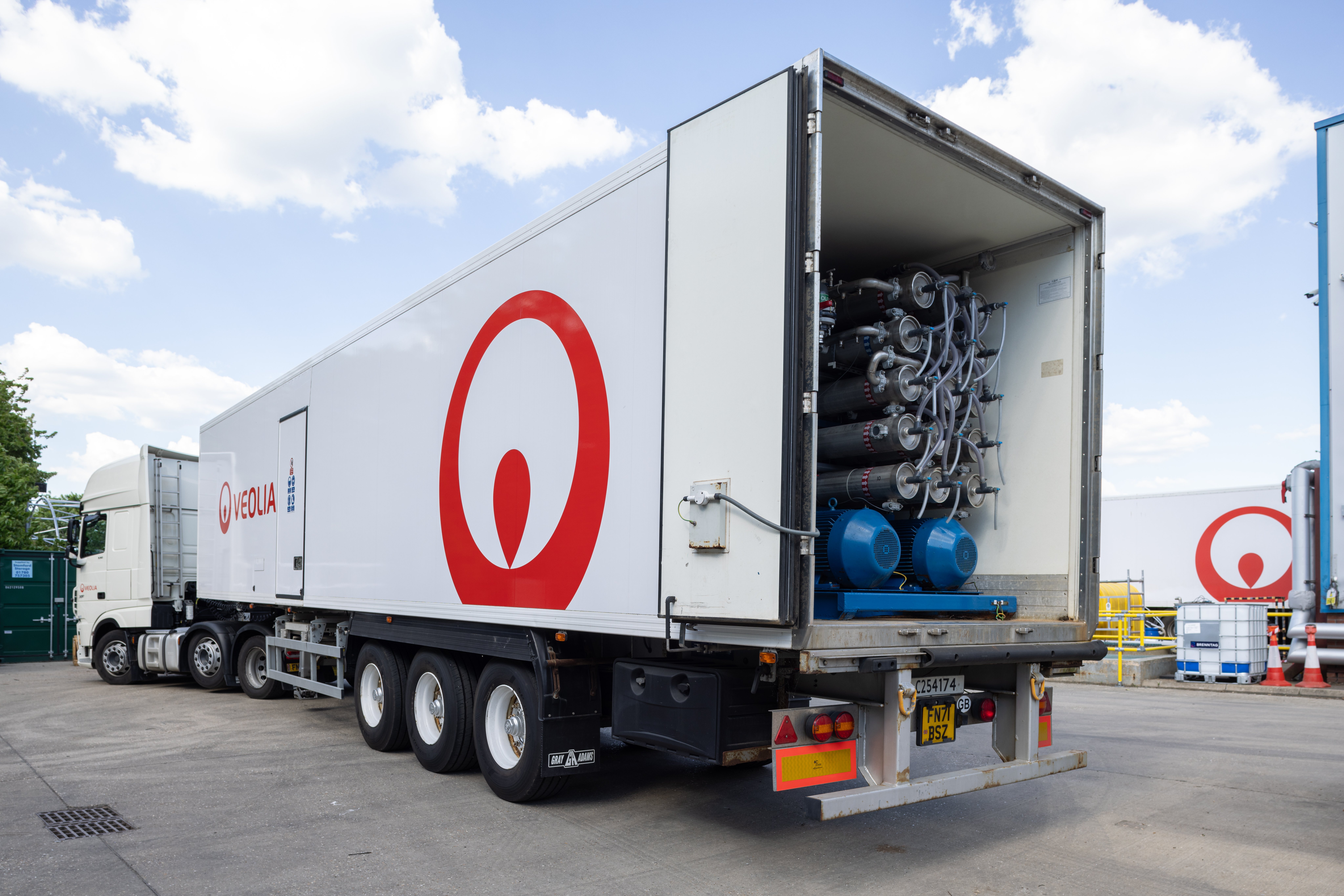 A quickly deployable reverse osmosis trailer available from Veolia mobile water fleet.
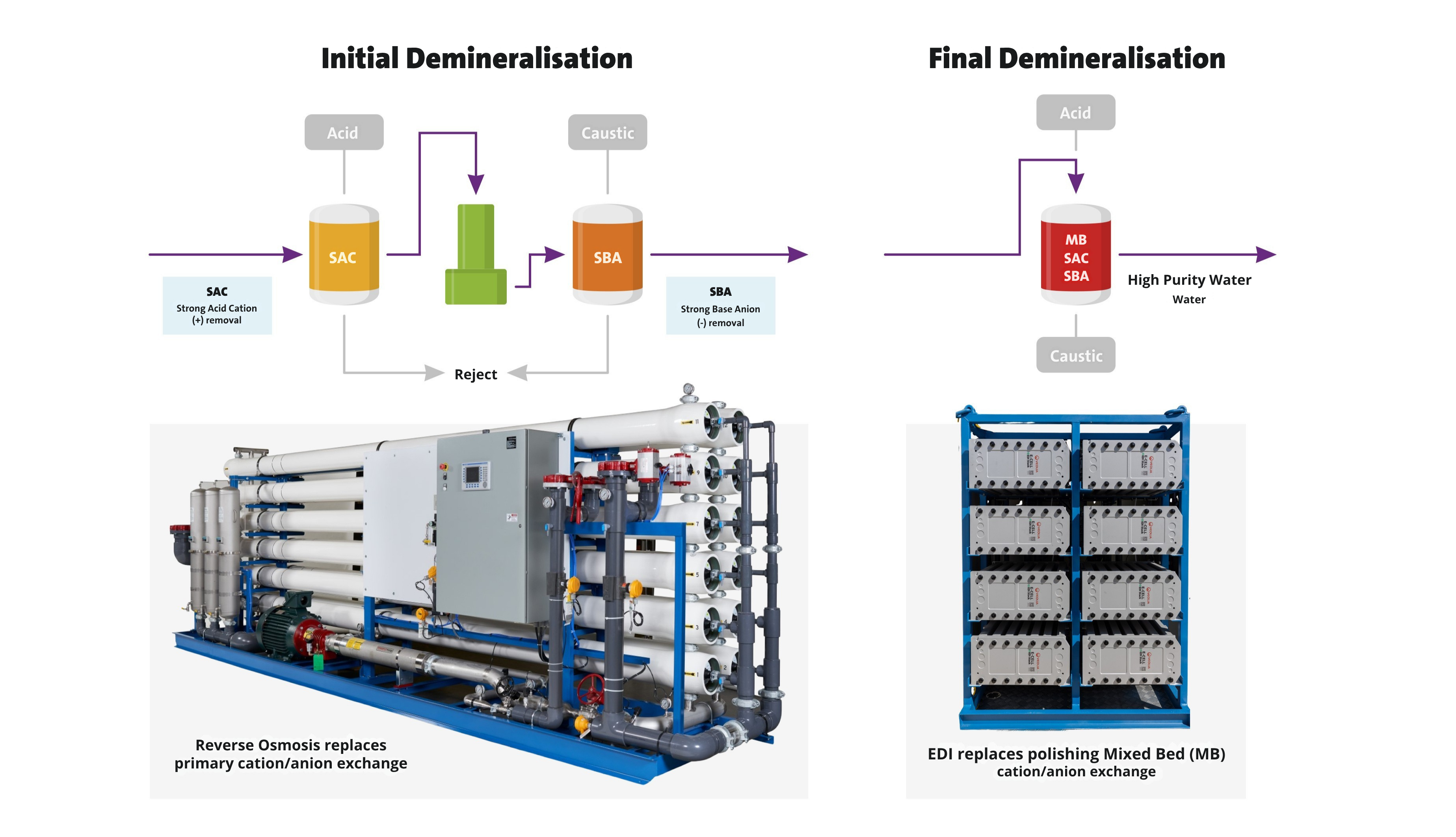
Mobile RO Upstream of IX – Reduce Caustic Demand
Deploying a mobile reverse osmosis (RO) unit upstream of your existing ion exchange plant is one of the most effective and immediate steps you can take.
Reverse osmosis eliminates the vast majority of dissolved ions from your feedwater before it ever reaches the IX resin beds. This dramatically reduces the ionic load that the resin must handle, which means fewer regeneration cycles and significantly less caustic consumed per unit of treated water produced.
This approach protects your existing IX asset investment. There is no need to decommission or bypass your current system. Mobile RO works with it, extending the life of each regeneration cycle and reducing your chemical exposure at a time when that exposure carries real financial and operational risk.
Mobile RO units can be on-site and operational within days, not weeks or months, and require no capital expenditure. It is a practical, low-disruption intervention that delivers measurable results quickly.
Mobile EDI – Near Elimination of Chemical Regeneration
For industries requiring consistently high-purity water, mobile electrodeionization (EDI) offers another option.
EDI produces high-purity water continuously, without the need for chemical regeneration. It achieves this by combining ion exchange resin with ion exchange membranes and a low-level electrical current, which continuously regenerates the resin in situ. The result is a near-caustic-free polishing process that delivers reliable, high-quality output around the clock.
Mobile EDI units can be deployed as a bridge solution while your permanent infrastructure is assessed, or used to supplement existing capacity during periods of peak demand or chemical constraint. For facilities where water purity is non-negotiable, EDI removes the chemical supply chain from the equation almost entirely.
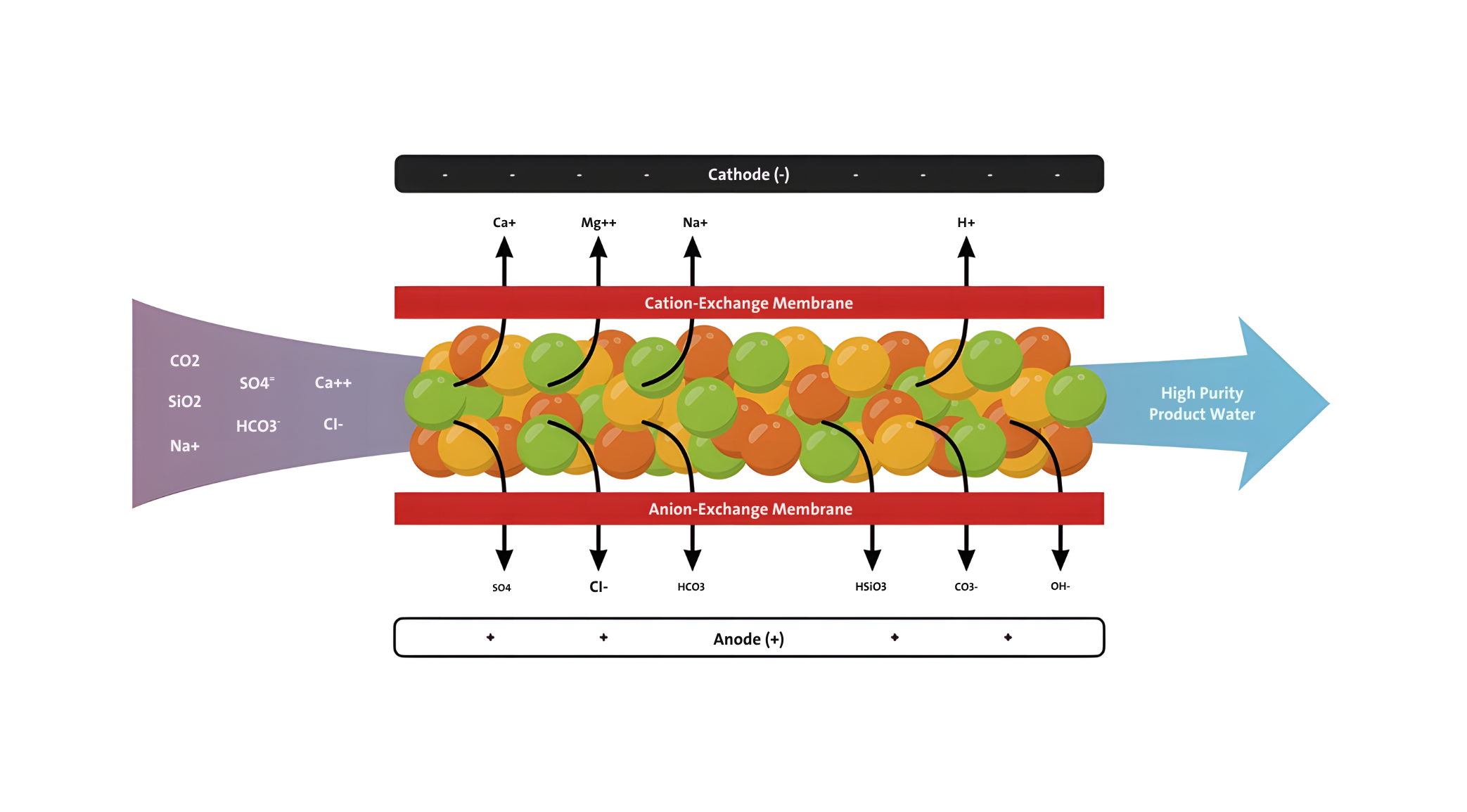 EDI flow schematic
Real World Proof: €1.2 Million Saved at a European Refinery
A leading European oil and gas refinery faced an urgent challenge. With its demineralisation plant undergoing refurbishment and its high-pressure boilers being modernised, it needed a reliable, continuous supply of high-purity demineralised water — with no CAPEX budget, limited space and a skeleton on-site team.
Veolia deployed a pioneering mobile RO and EDI solution — eliminating the need for traditional ion exchange chemical regeneration entirely. The result? Chemical savings of 26.3 tonnes of NaOH and 14 tonnes of HCl per year, 44 annual trailer movements eliminated, 125 tonnes of CO₂ avoided annually, and total cost savings exceeding €1.2 million since implementation — all compared to a conventional mobile ion exchange alternative.
This is exactly the kind of solution that can protect your plant when caustic supply chains come under pressure.

The Speed Advantage of Mobile
Unlike permanent installations, which require capital approval, procurement, civil works and commissioning timelines measured in months, mobile water treatment units can be on-site and producing water within days.
Veolia's mobile fleet is strategically positioned across Europe, with the logistics capability to mobilise rapidly to your site. There is no capital expenditure required; mobile solutions operate on an operational expenditure model, with flexible contract options ranging from emergency short-term deployment to multi-year rental arrangements. Capacity is scalable to match your specific water demand, and Veolia's team provides full technical support, maintenance, consumables and 24/7 remote monitoring throughout the deployment.
Contact our mobile water services team to learn more
The Case for Contingency Planning
Every well-run industrial facility already has contingency plans in place for power outages, equipment failures and emergency chemical stocks. A mobile water treatment contingency plan deserves exactly the same status and the same level of prior preparation.
Waiting until a caustic supply crisis is already underway is the most expensive approach. Lead times for emergency mobilisation, even with a responsive partner, are always shorter when the groundwork has already been done. A pre-agreed contingency plan means that if the situation deteriorates, your response time is measured in hours, not weeks.
Veolia mobile water services can work with your team now, before any crisis develops to:
- Assess your caustic dependency and vulnerability, quantifying your exposure under different price and availability scenarios
- Design a tailored mobile water contingency solution, whether RO, EDI, or a combination, matched to your site's specific water quality and volume requirements
- Pre-agree mobilisation terms, so that if you need to activate the plan, the commercial and logistical framework is already in place
The cost of this planning is significantly lower than being unprepared.
In a market environment where chemical supply chains have demonstrated they can be disrupted at speed and scale, having a credible water treatment contingency plan is simply good engineering and good business.
Don't Wait for a Crisis to Act
World events that have caused plant shutdowns before are present again. But a solution exists, it is proven, and it can be deployed faster than most plant managers realise.
Veolia operates one of Europe's largest mobile water treatment fleets, with decades of experience supporting heavy process industries through exactly these kinds of supply chain challenges. From emergency response within 24 hours to planned multi-year rental solutions, our mobile RO, EDI and IX support services are designed to keep your plant running, whatever the supply chain throws at you.
All industrial facilities require routine maintenance shutdowns to ensure their operations continue performing at their best. However, this doesn't mean your essential water supply and treatment infrastructure needs to be interrupted. With our Planned Outage Plans, we ensure a reliable supply of water that meets the required quality standards, keeping things running smoothly even while your main systems are temporarily out of service.