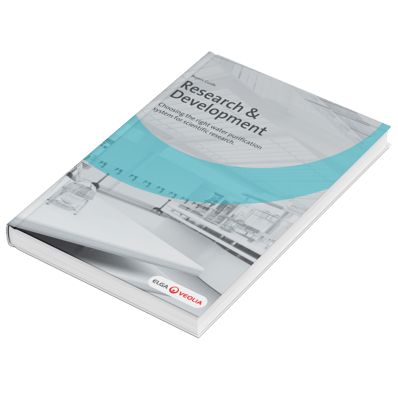


Water is the most critical reagent in scientific research and development facilities, so choosing the right purification system is vital to ensure an uninterrupted workflow with a constant supply of pure water.
Most R&D projects and laboratory work require a constant supply of pure water. Whether it's primary grade water for routine washing and rinsing tasks, or ultrapure water for more precise research applications, ensuring a reliable pure water supply is essential. This helps mitigate contamination risks that could impact the accuracy of test results and potentially damage equipment. However, choosing the right purification system to suit specific applications can be a complex task.
Not all purity is equal
The first step you need to consider is what level of water purity you need.
Type I or ultrapure water (resistivity: >18 MΩ.cm at 25°C) has achieved the highest level of purification and is used as a reagent in highly sensitive scientific and microbiological applications such as HPLC, LC-MS, AAS, ICP-MS, GC, molecular biology, and mammalian cell culture.
Type II purified water (resistivity: 1-10 MΩ.cm at 25°C) is typically used in general laboratory functions such as media preparation, buffer creation and preparing pH solutions.
Type III primary grade water (resistivity: 0.05-1 MΩ.cm at 25°C) is used for non-critical work such as glassware rinsing, filling water baths, and autoclave and disinfector feeds.
Safeguarding against contamination
Assessing whether experiments could be affected by organic contaminants is another important consideration. A purification system that monitors total organic content can be beneficial, as these technologies detect and control contaminants to ensure water quality meets stringent standards.
For applications sensitive to ionic contaminants, a system that monitors water resistivity can ensure that water of adequate purity is consistently delivered.
Questions to ask at this stage include:
- What daily water volume do you require?
- Which purity grades do you need simultaneously?
- Do you require real-time monitoring at the point of use?
- What's your laboratory's physical footprint?
- What are your sustainability requirements?
- What's your total cost of ownership budget?
The quality of feedwater is another factor to consider. Prefiltration can be required to deal with impurities in municipal water in order to protect purification technologies from damage.
Prepare for tomorrow with scalable and sustainable purification solutions
If you choose the wrong system it can result in interruptions to workflow, costing time and money in the cleaning and replacement of parts, as well as project downtime and reagent wastage. In contrast, if you have the right water purification system, it will improve the productivity, efficiency and accuracy of your lab’s outputs.
The key is in selecting a modular system that allows for easy expansion without increasing the environmental footprint of your operations. Look for efficient designs that minimise water and energy consumption, reduce plastic use and chemical waste, and ensure compliance with environmental standards.
How can we help?
Veolia’s range of water purification systems offer bespoke, efficient, modular solutions for all types of water purity, laboratory applications, budget and production demands. With our ELGA solutions, R&D laboratories can produce a compliant supply of Type I, II and III water in compact and easy to use products that slot seamlessly into any lab.
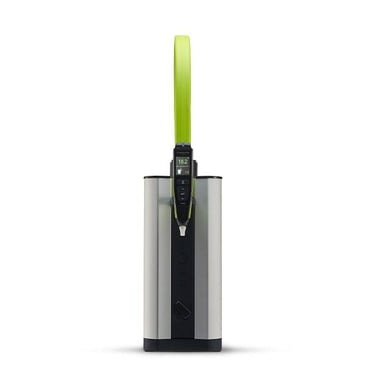
For example, the PURELAB® flex 3, one of our latest products, produces Type I water directly from potable tap water. Designed for labs which require smaller volumes of water, and where space is at a premium, the Flex 3’s design makes it easy to incorporate into any lab set up – either as a desktop solution or mounted to the wall. What’s more, with a fully recirculating system and real time TOC monitoring, you can be confident that your water meets the necessary standards for organic purity, without the need for additional analysing equipment.
Alternatively, the PURELAB® Chorus 1 delivers Type I and Type I+ water for those labs demanding the very highest levels of water purity. Through our PureSure® deionisation system, the Chorus 1 maximises the use of consumables whilst inspiring confidence with a multi-sensor system that informs users of any changes in resistivity, providing ample time to change purification packs, and keeping water quality at its best all the time.
Because we have been working with scientists for over 80 years, we have a detailed understanding that enables us to help you navigate the challenges that can arise during the development, installation, and servicing of purification systems. We also offer a complementary and comprehensive range of services that enable clients to guarantee the operation and continuity of production facilities, extending the lifespan of water purification systems and minimising operational costs.
Take action today
Don't let water quality compromise your research outcomes. Download our comprehensive Research and Development Buyer's Guide for a step-by-step approach to selecting the perfect purification system for your laboratory.