


Food industry companies, especially those in water-intensive segments such as the meat and dairy industries, face multiple challenges: strictly complying with national regulations, anticipating regulatory changes, and turning production waste into business opportunities.
The wastewater generated by the food industry comes not only from production processes, but also from water used in cleaning operations and, more generally, from all the water used across the facilities.
For this reason, the composition of wastewater can vary considerably depending on the season and the production processes. This wastewater is usually rich in nutrients, mainly carbonaceous organic matter (COD – Chemical Oxygen Demand and BOD – Biochemical Oxygen Demand), as well as nitrogen and phosphorus.
Nitrogen Management in Wastewater
Although anaerobic treatments are highly efficient at removing a large portion of biodegradable COD, their main limitation lies in their reduced capacity to remove nutrients such as nitrogen and phosphorus.
For this reason, companies must pay close attention to discharge limits established for nitrogen forms (ammonia, nitrates, nitrites, organic nitrogen, and total nitrogen) and phosphorus. It is essential to carefully assess the need to implement biological nitrification/denitrification processes and phosphorus removal in the treatment chain, for example, after anaerobic processes.
When it comes to nitrogen management, combined nitrification and denitrification processes make it possible to transform ammoniacal nitrogen into gaseous nitrogen. Of these two biological processes, nitrification is undoubtedly the slower one, which significantly impacts the total volumes required for treatment processes and, consequently, the level of investment needed.
In addition to their slow growth, nitrifying bacteria are extremely sensitive to temperature variations and to the qualitative and quantitative fluctuations typical of wastewater from the food industry. Treatment plants are therefore likely to experience periods in which nitrogen concentrations in the effluent are unstable and do not comply with regulatory limits. Another common scenario is that the production capacity of the facilities is limited precisely by the treatment plant’s capacity to remove nitrogen.
Technologies to improve capacity and stability
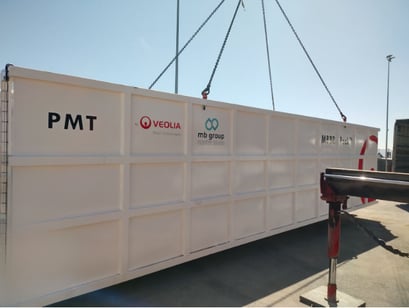
Today, the technology market offers solutions capable of increasing treatment capacity and stability without increasing existing biological volumes, improving, for example, the performance of conventional activated sludge plants. For new treatment installations, it is possible to directly implement compact and efficient technologies, reducing civil works and minimizing the impact of treatment infrastructure on the facilities.
AnoxKaldnes™ MBBR biological systems (moving bed biofilm reactor) and AnoxKaldnes Hybas™ (hybrid biofilm and activated sludge system) are widely used in the treatment of food industry wastewater due to their high efficiency per unit volume, greater stability in the face of wastewater variations, and their ability to be integrated into existing infrastructure to increase treatment capacity safely and quickly.
The implementation of AnoxKaldnes™ treatment plants generally makes it possible to double the treatment capacity of an existing conventional activated sludge plant and reduce the volumes required for new installations by up to 70%.
Conclusions
Environmental sustainability has become a strategic priority for many companies, especially in the food industry, where businesses have traditionally valued their connection to the local area and the development of a circular economy.
In the European context, EU wastewater treatment directives and the objectives of the European Green Deal are driving industries to adopt more efficient and sustainable technologies. Various European and national funding programs offer significant incentives to support treatment plant modernization and optimization projects, helping companies transition toward more efficient processes such as those described in this article.
Investing in these technologies not only ensures regulatory compliance, but also creates an opportunity to improve competitiveness and reduce the environmental impact of industrial operations.
Ready to optimize nitrogen management at your plant?